
Brain–Computer Interfaces (BCI)
The Future of Human–Machine Connection

"My name is Imran Anwar, currently a third-year BTech student majoring in Computer Science and Engineering. While I am still in the process of gaining professional experience, my ambition is to excel as a DevOps Engineer specializing in cloud infrastructure. I have a keen interest and foundational knowledge in AWS, with aspirations to design, implement, and manage highly scalable architectures using core services such as EC2, S3, RDS, and Lambda. I am proficient in infrastructure as code tools like Terraform and CloudFormation and have hands-on experience setting up CI/CD pipelines using Jenkins and AWS CodePipeline. Additionally, my skills extend to container orchestration using Docker and Kubernetes, and I have implemented robust monitoring solutions using CloudWatch and Elasticsearch.
I pride myself on being a quick learner and a problem solver, consistently seeking opportunities to expand my skill set and tackle challenges head-on. My strong communication and collaboration skills enable me to effectively engage with cross-functional teams, including developers and operations personnel. I am deeply passionate about cloud computing and am eager to leverage AWS services to drive innovation and deliver impactful business outcomes."
Brain–Computer Interfaces (BCI): The Future of Human–Machine Connection. The boundary between human cognition and machine interaction is dissolving. What once belonged to science fiction—controlling devices with pure thought—is now a rapidly advancing field known as Brain–Computer Interfaces (BCIs). This technology promises not just convenience but a fundamental shift in how humans interact with the digital world.
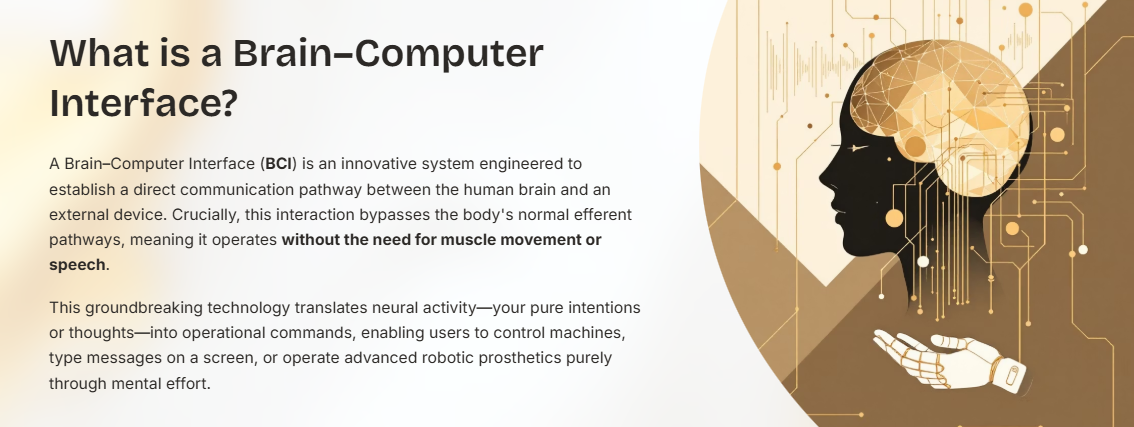
What is a Brain–Computer Interface?
A Brain–Computer Interface (BCI) is a system that enables direct communication between the human brain and an external device. Unlike traditional interfaces—keyboards, touchscreens, or voice commands—BCIs bypass the body’s normal communication pathways like muscles and speech. Instead, they interpret neural activity—your thoughts—and convert them into actionable commands. This means a person can type, move a cursor, or even control a robotic limb simply by thinking. This capability is especially transformative for individuals with paralysis or neurological disorders, offering them a new channel to interact with the world.
How BCIs Work?
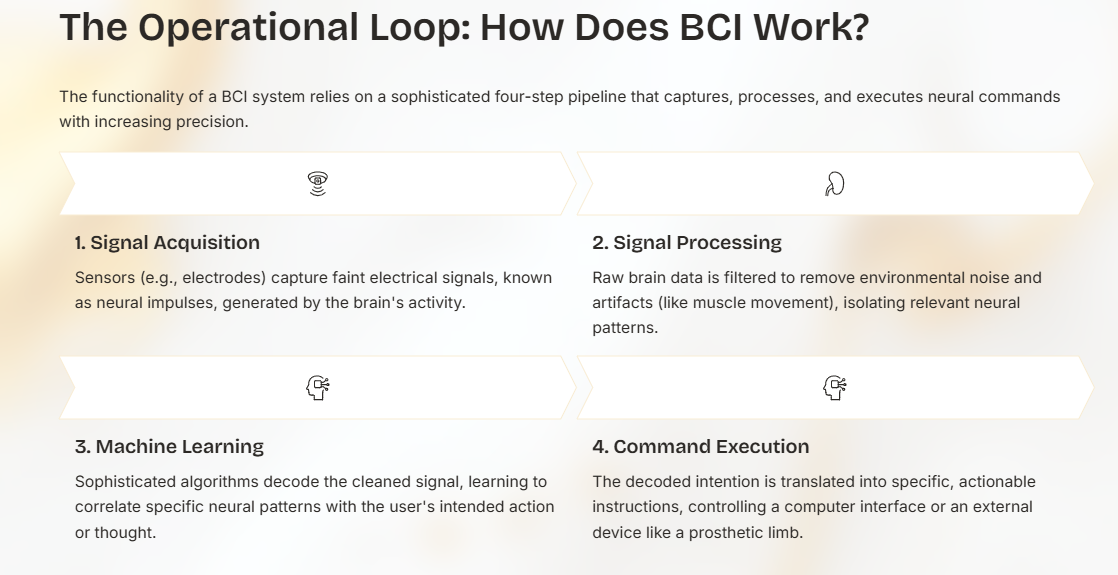
The Operational Loop. At its core, a BCI system follows a structured pipeline that transforms raw brain signals into meaningful actions.
Signal Acquisition Sensors, such as electrodes, capture electrical signals generated by neurons in the brain.
Signal Processing: The raw data is filtered to remove noise—such as muscle movement or environmental interference —leaving only relevant neural signals.
Machine Learning & Decoding Algorithms analyze these signals and learn patterns associated with specific thoughts or intentions.
Command Execution: The decoded signals are translated into commands that control devices such as computers, prosthetics, or software systems. This loop operates continuously, improving accuracy as the system learns from the user over time.
Types of BCIs:
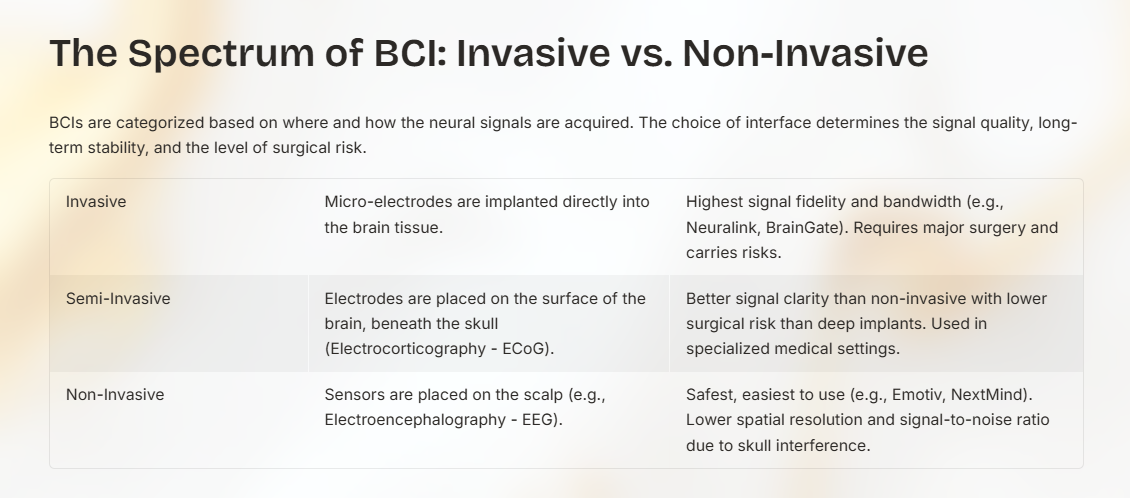
Invasive vs. non-invasive BCIs vary significantly in how they access brain signals. Each approach involves trade-offs between accuracy, safety, and practicality. Invasive BCIs Electrodes are implanted directly into the brain tissue. • Highest signal quality • Enables precise control • Requires brain surgery and carries medical risks. Companies like Neuralink and BrainGate are leading this category. Semi-Invasive BCIs: Electrodes are placed on the brain’s surface (beneath the skull). • Better signal quality than non-invasive • Lower risk than deep implants • Used mainly in clinical environments Non-Invasive BCIs Sensors are placed on the scalp using technologies like EEG. • Completely safe and accessible • Lower signal accuracy due to skull interference Devices from Emotiv are widely used in this space.
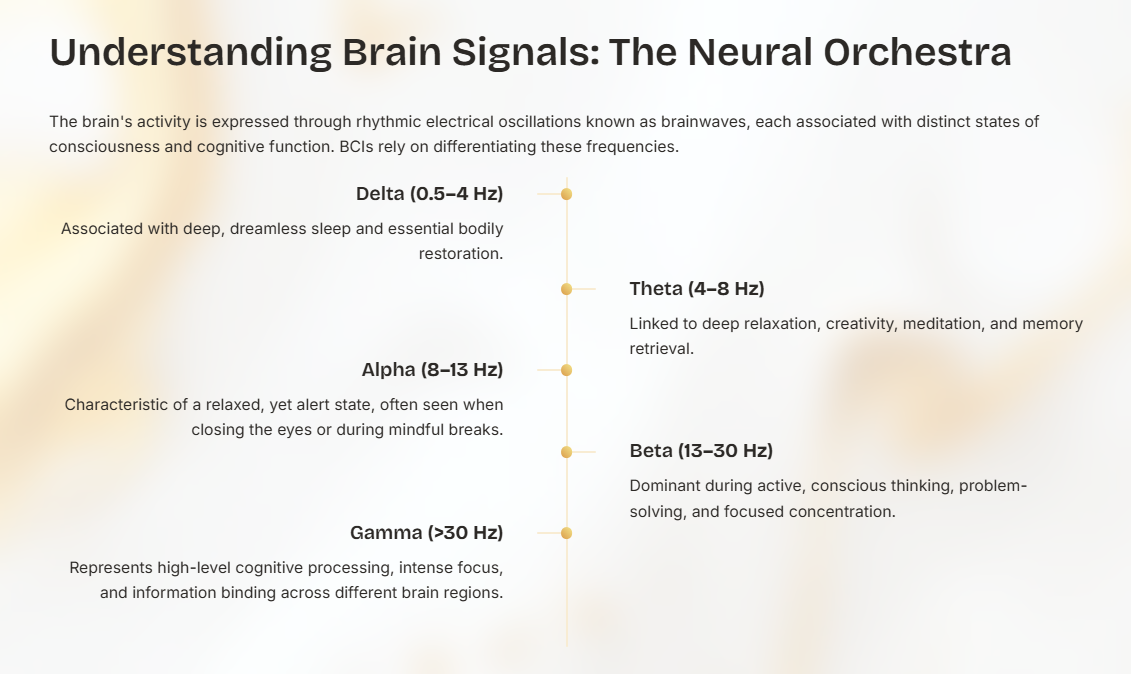
Understanding Brain Signals: The Language of the Brain. The brain communicates through electrical oscillations known as brainwaves. BCIs decode these patterns to interpret mental states and intentions. • Delta (0.5–4 Hz): Deep sleep and recovery • Theta (4–8 Hz): Creativity and meditation • Alpha (8–13 Hz): Relaxed alertness • Beta (13–30 Hz): Active thinking and focus • Gamma (>30 Hz): High-level cognition and information processing Think of these waves as the “language” BCIs must learn to understand.
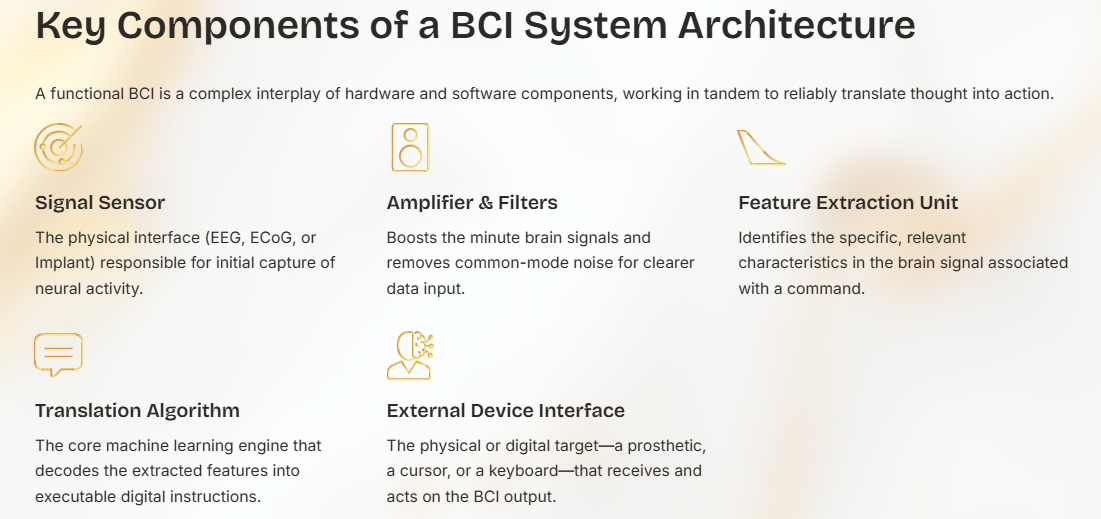
Core Components of a BCI System A functioning BCI is a blend of hardware and intelligent software: • Signal Sensors: Capture neural activity (EEG, implants) • Amplifiers & Filters: Strengthen signals and remove noise • Feature Extraction: Identify meaningful signal patterns • Translation Algorithms: Convert signals into commands • Device Interface: Executes actions (cursor, prosthetic, etc.) Together, these components form a seamless bridge between thought and action.
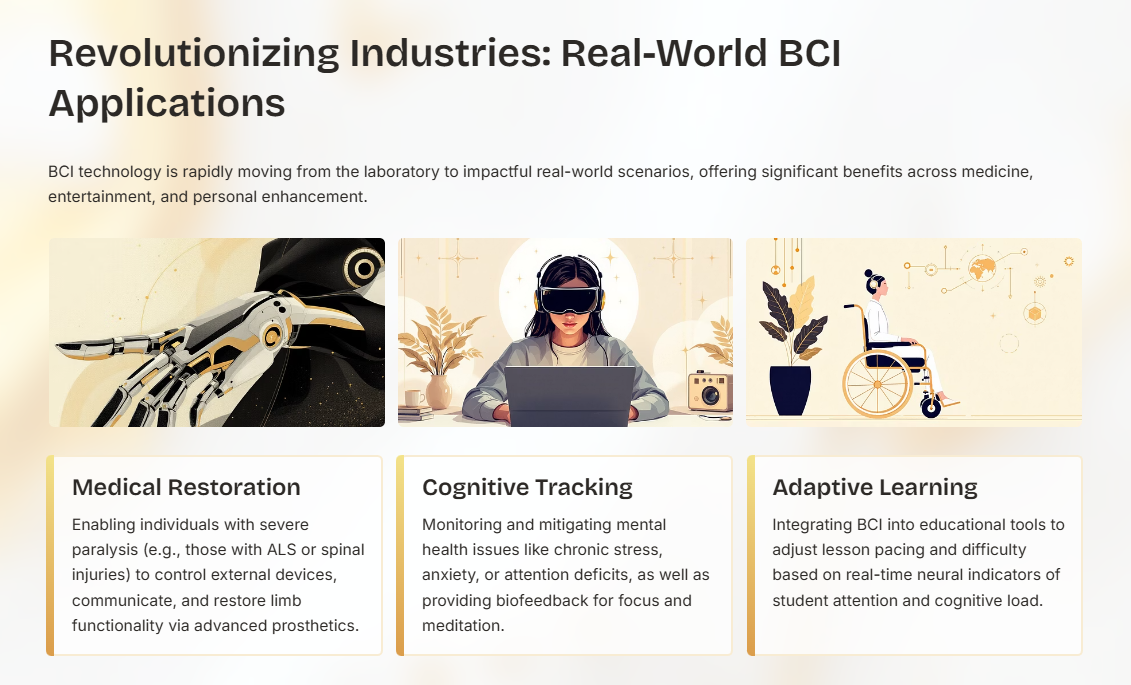
Real-World Applications of BCIs BCIs are no longer experimental—they’re actively transforming industries. Medical Restoration Patients with paralysis or ALS can control prosthetic limbs or communicate via computers, restoring independence. Cognitive Monitoring BCIs can track stress, attention, and mental health, enabling better interventions and biofeedback systems. Adaptive Learning Education systems can adjust in real-time based on a student’s focus and cognitive load, making learning more personalized.
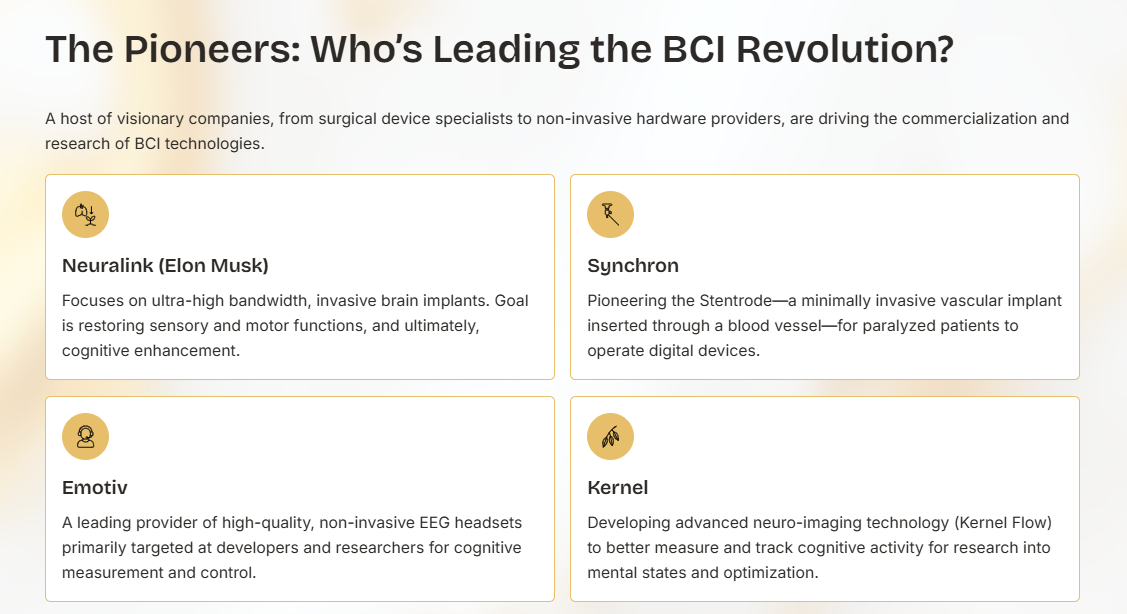
Key Players Driving the BCI Revolution Several companies are pushing the boundaries of what BCIs can achieve: • Neuralink — High-bandwidth implants for medical restoration and future enhancement • Synchron — Minimally invasive “Stentrode” technology • Emotiv — Non-invasive consumer-grade EEG systems • Kernel — Advanced brain imaging for cognitive insights These organizations represent different philosophies—ranging from surgical precision to accessible consumer tech.
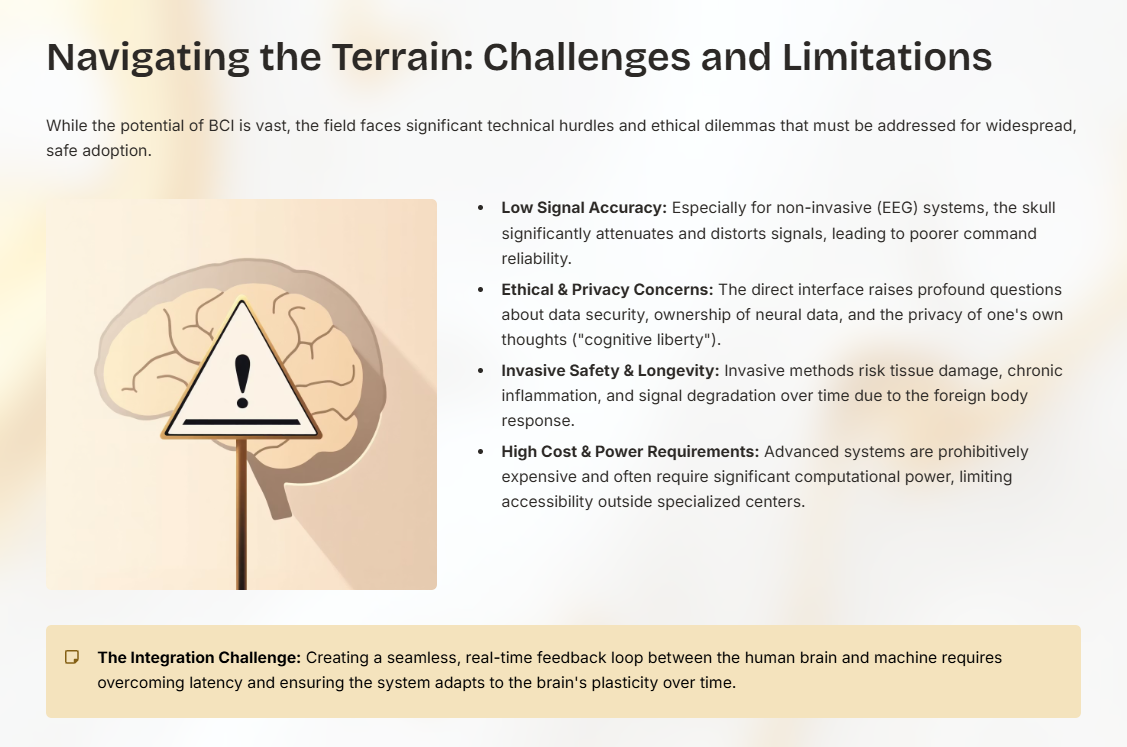
Challenges and Ethical Concerns Despite its promise, BCI technology faces significant hurdles.
Signal Accuracy Non-invasive systems struggle with noisy and weak signals.
Safety Risks: Invasive implants can cause tissue damage or degrade over time.
Privacy and Ethics: Who owns your brain data? Could thoughts be hacked or monitored?
Cost and Accessibility: Advanced systems remain expensive and limited to specialized environments.
Integration Complexity: Creating seamless, real-time interaction between brain and machine is still technically challenging. These are not just technical issues—they’re societal questions that will shape the future of BCI adoption.
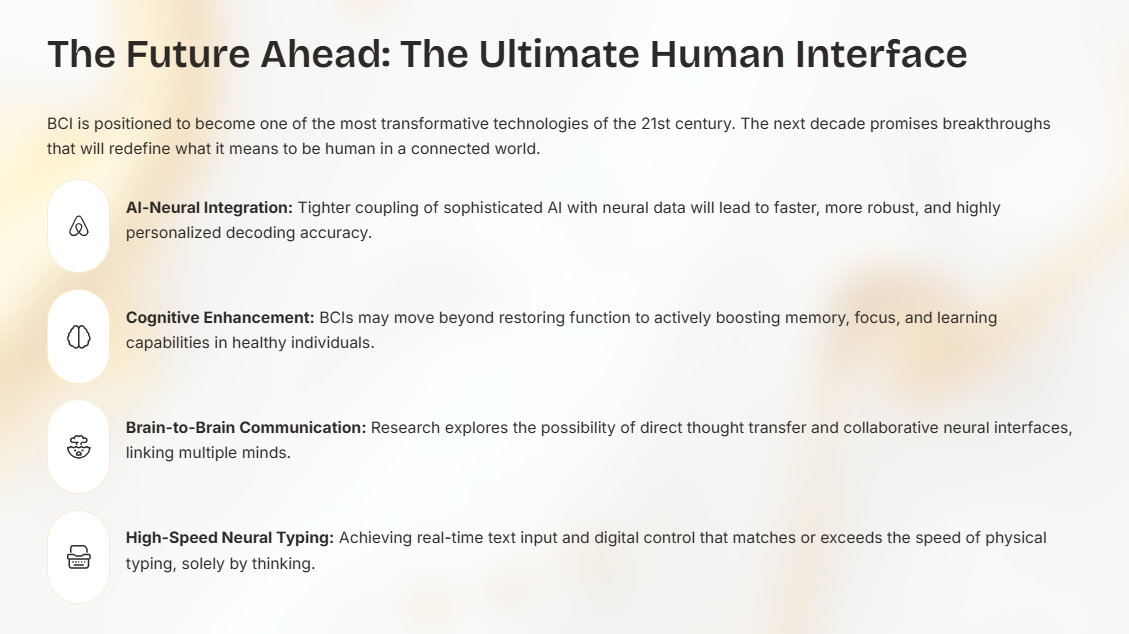
The Future of BCIs The next decade could redefine human capability. AI + Brain Integration Artificial intelligence will dramatically improve decoding accuracy and personalization. Cognitive Enhancement Beyond restoring lost function, BCIs may enhance memory, focus, and learning in healthy individuals. Brain-to-Brain Communication: Direct transmission of thoughts between individuals could become possible. Thought-Based Typing: Typing speed using pure thought may rival or surpass physical keyboards.
Conclusion
Brain–computer interfaces are reshaping the boundary between mind and machine by translating neural activity into actionable commands. From invasive implants to noninvasive wearables, BCIs open powerful avenues for restoring lost function, enabling new forms of communication, and extending human capabilities. Their operational pipeline—signal acquisition, preprocessing, feature extraction, decoding, and feedback—turns fleeting brain signals into reliable interactions, but doing so requires careful engineering and robust algorithms.
Despite impressive progress, significant challenges remain: improving signal quality and longevity, ensuring safety and usability, addressing privacy and security of neural data, and navigating complex ethical and regulatory landscapes. The most promising advances will likely come from multidisciplinary efforts that combine neuroscience, machine learning, materials science, and human-centered design.
Looking ahead, BCIs hold the potential to move beyond clinical applications into broader consumer and industrial domains, especially as noninvasive methods become more capable and AI-driven decoding improves. Realizing this potential responsibly demands transparent research, inclusive policy-making, and strong safeguards to protect users’ autonomy and dignity.
Ultimately, BCIs are not just new tools—they represent a shift in how we conceive interaction itself. With thoughtful development and ethical stewardship, BCIs can empower people, expand human expression, and redefine what it means to interface with technology.